
We recently published the 2025 Veterans History Project for the John A. Stahl Library, in West Point, Nebraska.
The 136-page book includes stories of 36 individuals, with their own photographs, as well as images of, and information about, veteran memorials in West Point.
One of the veterans included in the book was the first officer to cross the famous Remagen bridge over the Rhine during the final push by the Allied forces into Nazi Germany. Karl H. Timmermann served in the U.S. Army from 1940-1951.
Read the text of his story or look inside the book, below:
Karl H. Timmermann was born on June 19, 1922, in Frankfurt am Main, Germany. He was one of six children, four of whom survived past infancy. On January 9, 1924, Karl arrived in New York and was naturalized as a U.S. citizen. His family moved to Nebraska when Karl was seven years old. Karl attended Guardian Angels School in West Point, NE and graduated in high school in 1940.
Following high school, he enlisted in the U.S. Army in the Infantry branch on July 6, 1940. He was stationed at Fort Lewis, Washington, and assigned to the 15th Infantry Division. After the Japanese military attacked Pearl Harbor, his unit began training for war. The 3rd Infantry Division, with the 41st Infantry Division, was then part of IX Corps. This army division spent most of WWII in charge of defenses on the West Coast of the United States, before moving to Hawaii and Leyte to plan and organize operations for U. S. forces advancing across the Pacific. In October 1942, Timmermann was selected for Officer Candidate School and was promoted to the rank of second lieutenant on February 16, 1943, at Fort Benning, Georgia. He then went to Fort Riley, Kansas for armored infantry training and was assigned as a platoon leader in Company A of the 27th Armored Infantry Battalion, 9th Armored Division.
Karl was given a furlough home in 1942. He began seeing LaVera Meyer. Timmermann proposed to her by letter with an enclosed ring, and she accepted by mail. The couple marred in Omaha, NE on May 25,1942. Karl then returned abroad. On December 16, 1944, the Germans began the Battle of the Bulge. Karl was a junior officer involved in the fighting near St. Vith with his platoon. His company’s entire kitchen staff and supply sergeant were captured and later executed by the German SS troops in what became known as the Malmedy Massacre. Timmermann was wounded in the arm by shell fragments during the fighting, but stayed with his unit until relieved, thus earning him a Purple Heart. The Germans announced that the 9th Armored Division had been destroyed during the battle, but it fought on, earning the nickname “Phantom Division.”
In late February 1945, Timmermann and the 9th Armored Division were supporting the right flank of British Field Marshal Bernard Montgomery’s forces.
On February 28, Karl’s daughter Gay Diane was born, but he did not learn of her birth for almost two weeks, due to him being on the front lines. On March 6, he took over Company A and acted as an advance guard for a combined armor and infantry drive to penetrate to the town of Remagen. Karl’s commander issued orders to seize Ludendorff Bridge before retreating critical support.
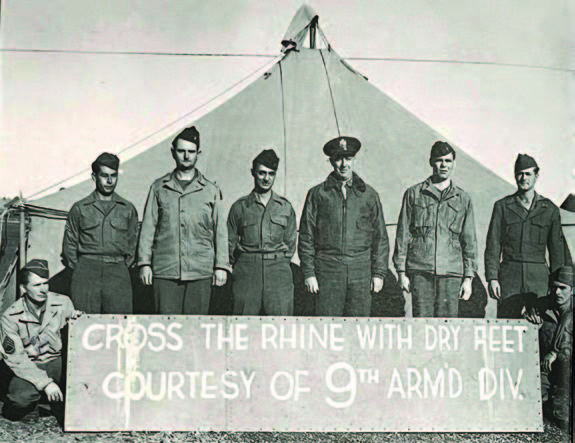
Lieutenant Timmermann led a patrol across the Remagen bridge to save it from destruction by the Nazis. Timmermann earned his title of “Hero of the Rhine” when he was the first officer to cross the Remagen bridge over the Rhine during the final WWII drive into Nazi Germany. He was among 13 decorated with the Distinguished Service Cross for capturing and crossing the bridge.
On VE day he was on the border of Czechoslovakia and until 1945, he served with the military government in northern Bavaria. He returned to the United States October 13, 1945. He was discharged as a first lieutenant December 12, 1945.
Timmermann reenlisted as a technical sergeant in the regular army on October 28, 1947. He was on recruiting duty in Fremont NE until August, 1948, when he became an instructor with the officers reserve corps. He was discharged on Christmas Day, 1948, and enlisted for active duty as an officer the following day.
Timmermann was assigned to the far East command on January 5, 1949, and was attached to the Seventh mechanized cavalry reconnaissance troop in the Seventh infantry division. He took part in the Inchon landing in Korea and subsequent battle Suwon in 1950.
It was during this time that he developed severe pain and it was discovered that he had a cancerous tumor. He was sent to Fitzsimmons Hospital, Denver where he had surgery. He died on October 21, 1951 and was buried at Fort Logan National Cemetery in Denver, Colorado.